
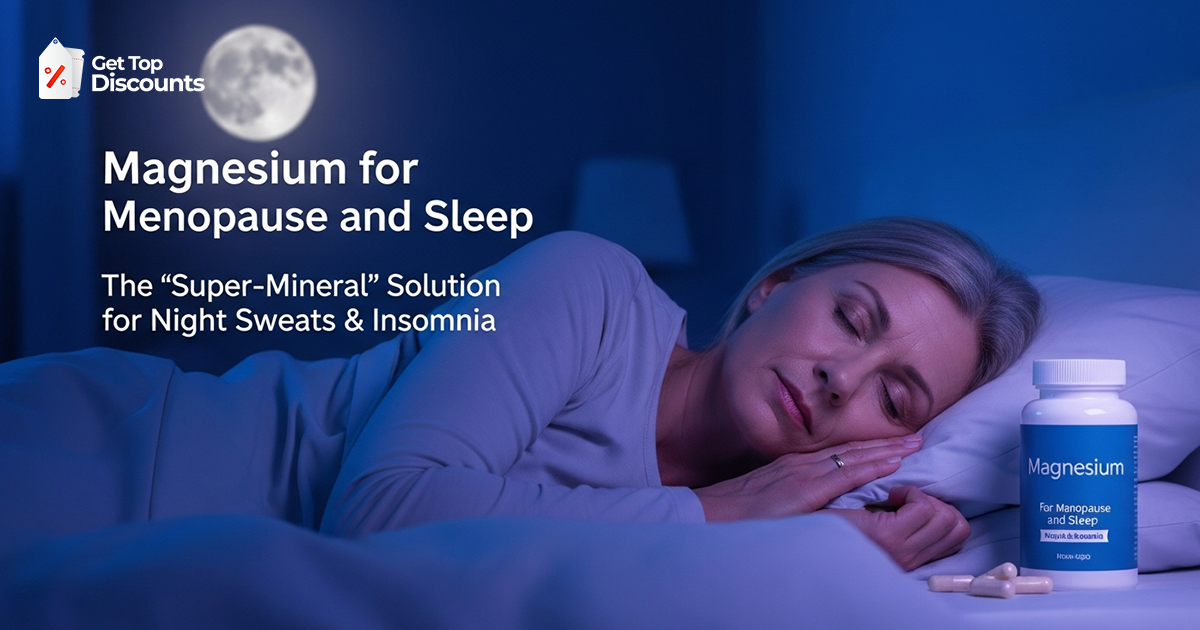
Menopause can quietly change how your nights feel.
You go to bed tired, expecting rest. But instead, your body wakes you up. You feel hot. You toss the blanket aside. Your mind starts thinking. You try to sleep again, but it does not come easily.
Then you check the time. It is 2 AM. Or 3 AM.
This becomes a pattern.
Many women going through menopause deal with:
- Night sweats
- Hot flashes
- Broken sleep
- Anxiety at night
- Feeling tired all day
It can feel confusing because your routine has not changed much, but your sleep has.
This is where magnesium starts to come into the picture.
But there is something important to understand: not all magnesium works the same way.
This guide explains the best magnesium for menopause and sleep, how it helps with night sweats and insomnia, and what actually works when used consistently.
Quick Answer: Best Magnesium for Menopause and Sleep
The best magnesium for menopause and sleep is a multi-form (full-spectrum) magnesium supplement.
Why?
Because menopause affects several systems at once:
- Hormones
- Nervous system
- Brain activity
- Body temperature
- Sleep cycles
If you only support one area, you may get small results.
If you support all of them together, sleep improves more fully.
What Changes in Your Body During Menopause?
To understand best magnesium for sleep menopause, you need to understand what your body is going through.
During menopause, estrogen levels drop. This affects how your body regulates temperature and stress.
This can lead to:
- Sudden heat at night
- Increased sensitivity to stress
- More active thoughts at bedtime
- Lighter sleep
- Frequent waking
Your body also reacts faster to small triggers.
Things that never affected you before can now:
- Wake you up
- Make you feel uncomfortable
- Keep your mind active
This is why sleep becomes unpredictable.
The Sleep Disruption Cycle in Menopause
Menopause does not just cause one issue. It creates a cycle.
Here is how it usually works:
- Hormonal changes increase stress sensitivity
- Stress keeps your mind active at night
- You struggle to fall asleep
- Night sweats wake you up
- You cannot return to deep sleep
- You feel tired the next day
- Fatigue increases stress
Then the cycle repeats.
This is why fixing only one part, like relaxation, often does not solve the problem.
Why Night Sweats Are So Disruptive?
Night sweats are one of the biggest reasons sleep breaks.
You may:
- Wake up feeling hot
- Throw off your blanket
- Try to cool down
- Feel uncomfortable
- Take time to fall asleep again
Even if you sleep again, your sleep becomes light.
Deep sleep gets interrupted.
Over time, this leads to:
- Poor recovery
- Low energy
- Brain fog
- Mood changes
This is why many women look for the best magnesium for menopause and sleep; they want something that helps both calm the body and support temperature balance.
Why Anxiety Gets Worse at Night?
During menopause, your body becomes more sensitive to stress.
At night, when everything is quiet, your thoughts can feel louder.
You may notice:
- Overthinking
- Worrying about small things
- Difficulty turning your mind off
This mental activity makes sleep harder.
Even if your body is tired, your brain stays active.
This is where magnesium can help—but only if you use the right type.
How Magnesium Supports the Body During Menopause?
Magnesium plays a role in many functions that affect sleep.
1. Helps Calm the Nervous System
Magnesium helps your body move from stress mode to rest mode.
This makes it easier to fall asleep.
2. Supports Body Temperature Stability
It helps your body regulate internal processes, which can reduce sudden temperature changes.
3. Supports Hormonal Function
Magnesium helps your body manage hormonal balance, which is important during menopause.
4. Helps Reduce Physical Tension
It relaxes muscles and reduces restlessness.
5. Supports Sleep Cycles
Magnesium helps your body move into deeper sleep stages.
This combination is why magnesium is often used for sleep support.
Why Single-Form Magnesium Often Does Not Work Fully?
Many women start with magnesium glycinate.
It is a good form. It helps with relaxation.
But often, the results feel incomplete.
You may notice:
- You feel slightly calmer
But still: - Wake up at night
- Experience night sweats
- Have active thoughts
This happens because one form cannot support everything.
Menopause affects multiple systems.
So the solution must support multiple systems too.
The Different Types of Magnesium and How They Help
To find the best magnesium for menopause and sleep, it helps to understand what each type does.
Magnesium glycinate → helps you relax
Supports calmness and reduces tension before bed.
Magnesium taurate → supports the nervous system
Helps reduce stress signals and supports heart function.
Magnesium L-threonate → supports brain function
Helps calm your mind and makes thinking clearer.
Magnesium malate → helps with energy
Reduces tiredness during the day, which helps your sleep routine.
Magnesium citrate → helps digestion
Improves comfort, which can help you sleep better.
Magnesium orotate → helps recovery
Supports your body in repair and balance.
Magnesium sucrosomial → helps absorption
Helps your body absorb magnesium better.
Each of these supports a different part of the sleep process.
Why Multi-Form Magnesium Works Better?
Now we can clearly answer:
What is the best magnesium for sleep menopause?
It is a multi-form magnesium blend.
Because it supports:
- Hormones
- Nervous system
- Brain activity
- Temperature balance
- Sleep cycles
Instead of helping one issue, it supports your whole system.
This leads to better and more clear results.
How Magnesium Helps With Night Sweats (Realistically)
Magnesium is not a quick fix.
But it helps your body manage stress and temperature.
With regular use, many women notice:
- Fewer night sweats
- Less intense heat
- More steady sleep
The results come slowly, but improve over time.
How Magnesium Helps With Insomnia?
Magnesium supports sleep in simple ways.
It Helps You Wind Down
Your body feels calmer before bed.
It Reduces Mental Noise
Your thoughts slow down.
It Supports Deeper Sleep
You stay asleep longer.
This improves both falling asleep and staying asleep.
What Real Improvement Looks Like?
The changes are often small at first.
You may notice:
- You feel calmer at night
- You fall asleep a bit faster
Then:
- You wake up less often
- Night sweats feel less intense
Later:
- Sleep feels deeper
- You wake up with more energy
These changes build step by step.
How Long Does Magnesium Take to Work?
Magnesium works gradually.
- First few days: mild calming effect
- 1 week: better sleep onset
- 2 weeks: deeper and more stable sleep
Consistency is important.
Taking it occasionally will not give strong results.
How to Take Magnesium for Best Results?
Keep it simple:
- Take it 30 to 60 minutes before bed
- Use it every night
- Stay consistent
You do not need a complex routine.
Regular use is what matters most.
Common Mistakes to Avoid
When choosing the best magnesium for menopause and sleep, avoid these:
1. Using Only One Type
This limits results.
2. Expecting Quick Results
Magnesium works over time.
3. Skipping Doses
Inconsistent use reduces effectiveness.
4. Ignoring Daily Habits
Caffeine, stress, and screen time still affect sleep.
Lifestyle Tips That Help Magnesium Work Better
Magnesium works better when you follow simple habits:
- Sleep at the same time every day
- Use screens less before bed
- Avoid caffeine in the evening
- Keep your room cool
- Drink enough water
These small steps can help you sleep better.
Choosing the Right Magnesium Supplement
When looking for the best magnesium for menopause and sleep, choose carefully.
Look for:
- Multiple forms of magnesium
- Good absorption support
- A formula designed for sleep and stress
This helps you avoid trial and error.
Browse the BiOptimizers Cycle Care and Magnesium deals for menopause support.
A mix of different forms works best because it supports multiple systems.
It may help reduce them by supporting body balance.
Yes, it supports relaxation and sleep cycles.
It helps, but it is not complete on its own.
30 to 60 minutes before bed.
Final Thoughts
Menopause can make sleep feel difficult and unpredictable.
Night sweats, anxiety, and insomnia often happen together. And fixing only one part usually does not work.
That is why the best magnesium for menopause and sleep is not a single type. It is a multi-form approach that supports your:
- Hormones
- Nervous system
- Brain
- Sleep cycle
With consistent use, you may start to:
- Sleep more deeply
- Wake up less often
- Feel calmer at night
- Have better energy during the day
These changes may start small.
But over time, they can make a big difference in how you feel every day.