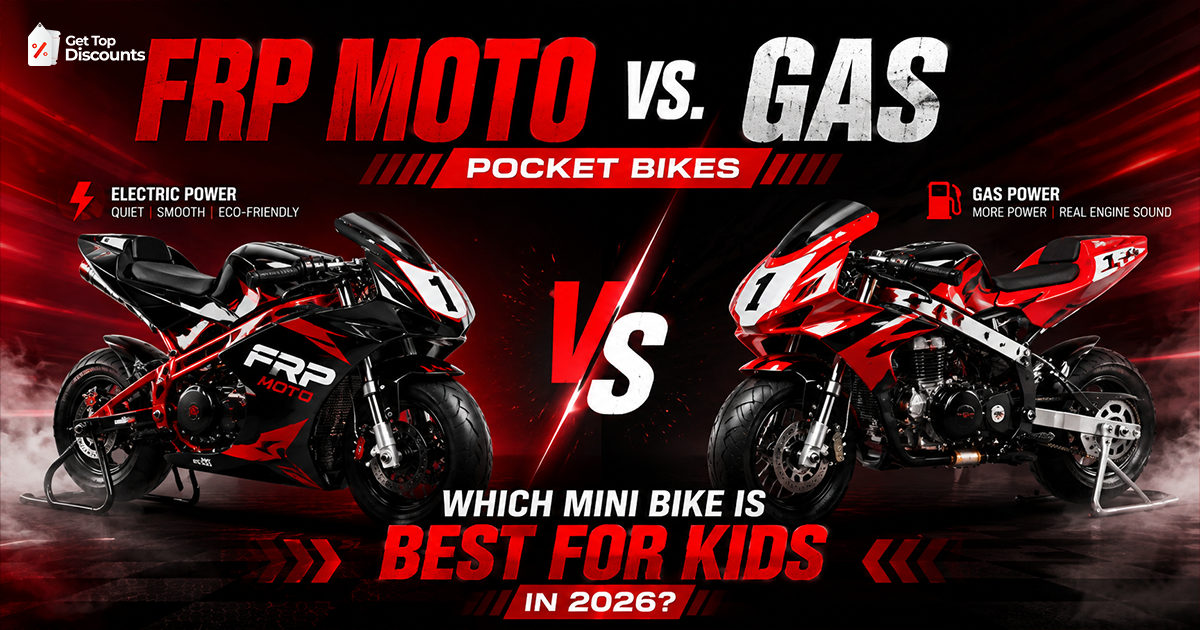
Choosing between FRP Moto vs Pocket Bikes comes down to more than engine size.
A 40cc FRP mini bike may have a smaller engine than a typical 49cc or 50cc gas pocket bike, but that does not automatically make it the weaker choice. For younger or first-time riders, factors such as riding position, throttle response, braking, suspension, weight capacity, and maintenance can matter much more.
FRP currently positions its MB40 as a beginner-oriented 40cc four-stroke mini bike for kids ages 6 and older. It has an automatic transmission, an emergency kill switch, an 18 mph listed top speed, and a 165 lb maximum rider capacity. The FX40 Ogemaw takes a more dirt-bike-style approach with full suspension, front and rear disc brakes, and a 20 mph listed top speed.
Traditional 49cc or 50cc gas pocket bikes are usually lower and more compact. Some also use two-stroke engines that require gasoline and oil to be mixed before use. That creates a very different ownership experience.
If you have already decided that an FRP model suits your child, you can get the best price on your first ride with an FRP Moto discount code. The Get Top Discounts page currently lists more than 10 FRP Moto offers and was last checked on August 10, 2026.
FRP Moto vs Pocket Bikes: Quick Verdict
For a younger beginner, an FRP 40cc four-stroke model is usually the easier format to understand.
The MB40 is built around a simple pull-start, automatic setup. There is no manual clutch or gear shifting to learn. FRP lists it at roughly 18 mph, while the FX40 reaches about 20 mph and adds full suspension plus front and rear disc brakes.
A typical 49cc or 50cc pocket bike can feel quite different.
For example, MotoTec’s current 49cc GT pocket bike uses a two-stroke engine, centrifugal transmission, 32:1 fuel-and-oil mixture, front and rear disc brakes, and small 11-inch street-style tires. Its overall dimensions are only about 39 inches long, 20 inches wide, and 23 inches high.
That low layout is part of the pocket-bike experience.
It may appeal to someone who specifically wants a miniature road-bike feel. For a child learning on dirt, grass, or uneven private property, a mini bike or dirt-bike layout may make more sense.
40cc vs 50cc Mini Bike: Does Engine Size Matter?
Parents often begin with the engine number.
40cc.
49cc.
50cc.
That number is useful, but it does not tell the whole story.
FRP’s 2026 kids lineup shows why. Its four 40cc machines range from about 13 mph to 20 mph even though the engine displacement is broadly the same. Rider capacity also ranges from 132 to 165 lb depending on the model.
So a larger engine does not automatically mean a better bike.
FRP 40cc Four-Stroke
The MB40 uses a 40cc air-cooled four-stroke engine.
That means gasoline goes into the fuel tank without the separate gas-and-oil premixing required by many small two-strokes. It is automatic and pull-start, which keeps the basic controls straightforward for a beginner.
The FX40 also uses a 40cc four-stroke but adds a speed limiter, full suspension, and dual disc brakes.
Typical 49cc or 50cc Two-Stroke
Many traditional pocket bikes use compact two-stroke engines.
A current MotoTec 49cc pocket bike, for example, calls for a 32:1 gasoline-to-two-stroke-oil mixture.
Some 50cc dirt-bike-style models can also be quicker.
MotoTec’s Thunder 50cc lists a 25 mph top speed with an adjustable limiter, while FRP notes that 50cc youth bikes can vary considerably depending on model and governor settings.
For a new rider, faster is not automatically better.
Control matters more.
FRP Moto vs Gas Pocket Bikes: Comparison Table
| Feature | FRP MB40 | FRP FX40 Ogemaw | Typical 49cc–50cc Pocket Bike |
| Engine | 40cc 4-stroke | 40cc 4-stroke | Often 49cc–50cc 2-stroke |
| Transmission | Automatic | Automatic | Usually centrifugal automatic |
| Listed Speed | About 18 mph | About 20 mph | Varies by model |
| Fuel | Gasoline | Gasoline | Often gas + 2-stroke oil |
| Brakes | Rear disc | Front + rear disc | Often front + rear disc |
| Suspension | Basic mini-bike setup | Full front + rear suspension | Often limited or road-focused |
| Rider Capacity | 165 lb | 132 lb | Varies |
| Best Use | Beginner riding | Dirt and uneven terrain | Low-profile pocket-bike riding |
| Assembly | About 85% complete | About 85% complete | Varies by brand |
| Beginner Focus | Strong | Strong | Depends heavily on model |
FRP publishes the MB40 and FX40 specifications directly, while pocket-bike specifications vary much more from one manufacturer to another.
Which Is Easier for a First-Time Rider?
For a first motorized bike, simplicity helps.
The MB40 has no manual clutch and no gear shifting. A young rider can focus on throttle control, braking, balance, and steering rather than coordinating several new controls at once.
The FX40 follows the same automatic approach but looks and behaves more like a small dirt bike.
Its full suspension makes it the more logical choice when the riding area includes bumps, grass, gravel, or uneven trails. Its adjustable speed limiter also gives a supervising adult more control over the beginner’s starting pace.
Pocket bikes sit much lower.
That can make them feel physically small, but a low seat does not automatically mean beginner-friendly. Small wheels, road-style tires, limited ground clearance, and different engine characteristics can change how the bike behaves.
For parents reading gas mini bike reviews, this distinction is worth remembering:
Fit the bike to the terrain and rider, not simply to the engine number.
What About Braking?
Braking should be high on the list when comparing the best kids dirt bikes.
The MB40 uses a rear disc brake. FRP pairs it with an emergency kill switch.
The FX40 goes further with front and rear disc brakes.
Many gas pocket bikes also have disc brakes at both ends. MotoTec’s GT 49cc is one example.
But the number of brakes is only one consideration.
The rider still needs a bike that fits properly and controls they can comfortably reach.
The Motorcycle Safety Foundation specifically warns against putting young riders on machines that are too tall or too powerful for their abilities. It also recommends direct supervision for riders younger than 16.
Which Bike Works Better on Dirt?
This is where a dirt-bike-style machine has an obvious design advantage.
The FX40 uses front and rear suspension and 2.5-10 knobby off-road tires. FRP lists it at 20 mph with a 132 lb rider limit.
That setup is intended for dirt, gravel, grass, and trail-style riding.
The MB40 is simpler but also uses knobby tires and is marketed for backyard, dirt, and gravel use on private property.
A low pocket bike with small street-oriented tires is a different product.
For example, MotoTec’s 49cc GT uses 11-inch pneumatic street tires.
If the main riding area is uneven dirt, we would prioritize tire design, suspension, brakes, and ground clearance over whether the engine says 40cc or 50cc.
Which One Is Easier to Maintain?
The engine type makes a noticeable difference here.
Four-Stroke FRP Models
The MB40 and FX40 run on gasoline without requiring the user to premix fuel and two-stroke oil.
That removes one recurring task from ownership.
There is still normal maintenance, of course.
Before each ride, a responsible adult should follow the manufacturer’s inspection guidance and make sure important controls and components are in proper condition.
For ongoing ownership information, to ensure longevity, read our guide on tuning your FRP Moto engine.
Two-Stroke Pocket Bikes
Small two-stroke engines commonly require fuel and oil to be mixed at a specified ratio.
That ratio is not universal.
One model may use 32:1 while another uses 25:1 or 50:1. The correct specification should always come from the bike’s own manual. Current MotoTec models illustrate this variation clearly.
For parents who want fewer fuel-preparation steps, a small four-stroke can be easier to manage.
Assembly Matters Too
FRP says both the MB40 and FX40 arrive around 85% pre-assembled.
That does not mean the final setup should be rushed.
A motorized bike needs to be assembled and inspected correctly before anyone rides it.
For parents preparing one as a birthday or holiday gift, before your first ride, follow our expert FRP mini bike assembly guide.
Do the assembly before the child is standing next to the box waiting to ride.
That gives you time to check the bike properly instead of rushing.
Which Is Better for Younger Kids?
Age is useful, but it is not enough on its own.
FRP currently markets the MB40 for riders around age 6 and above, while its FX40 guidance places that dirt-bike-style model more around school-age riders who are ready for trail riding.
FRP itself also advises parents to think about physical size, coordination, and the child’s ability to follow instructions, rather than relying only on birthday age.
A child should not be moved to a faster or larger bike simply because they reached a certain birthday.
Rider readiness matters.
Safety Gear Is Part of the Purchase
A gas mini bike is not a toy.
The Motorcycle Safety Foundation recommends a DOT-compliant helmet, goggles, gloves, long sleeves, long pants, and over-the-ankle boots for dirt-bike riders. It also advises supervising riders under 16 and using appropriate off-highway riding areas.
That means the budget should not stop at the bike.
Plan for proper riding gear at the same time.
Also check your local laws before use. FRP describes the MB40 as an off-road product for private-property use rather than a street-legal motorcycle.
FRP Moto Deals: What Should Parents Compare?
Do not buy the first bike simply because it has the largest percentage off.
First decide which model fits the rider.
Then compare:
- Bike price
- Shipping
- Safety equipment
- Replacement parts
- Warranty
- Engine type
- Rider weight limit
- Braking
- Suspension
- Expected terrain
After that, check the current FRP Moto Coupon offers.
A good FRP Moto Promo Code can lower the purchase price, but the cheapest bike is not necessarily the best long-term choice.
Parts availability matters too.
If a low-cost bike becomes unusable because a simple replacement component cannot be found, the original saving disappears quickly.
40cc vs 50cc Mini Bike: Which Should You Pick?
Here is the simpler way to think about it.
Pick a 40cc FRP MB40 if:
The rider is new to motorized bikes, already understands bicycle balance, and will mainly ride on suitable private-property surfaces.
Its 18 mph listed speed, automatic transmission, kill switch, and 165 lb capacity make it a straightforward entry point.
Pick the FRP FX40 if:
The rider will spend more time on dirt or uneven ground.
Its full suspension, front and rear disc brakes, adjustable speed limiter, and 20 mph top speed make it a more trail-focused option.
Consider a 49cc–50cc pocket bike if:
The rider specifically wants the compact pocket-bike format and the intended riding environment suits its low frame and tire setup.
Check the exact model carefully because 50cc bikes vary greatly in speed, suspension, age guidance, braking, and fuel requirements.
Is a 50cc Bike Automatically Better Than a 40cc?
No.
This is one of the biggest mistakes in the FRP Moto vs Pocket Bikes comparison.
Engine displacement is one specification.
A 40cc machine with better brakes, suitable suspension, a speed limiter, and a better fit can be more appropriate for a young rider than a faster 50cc model.
FRP’s own lineup demonstrates that even bikes with the same 40cc displacement behave differently depending on chassis, braking, suspension, and gearing.
Buy the whole bike.
Not the number printed on the engine.
Buying an FRP Moto as a Gift
A mini bike can be a memorable gift, but it requires more planning than an ordinary toy.
You need the right bike, safety equipment, a suitable riding location, and enough time to assemble and inspect everything.
FRP recommends matching a bike to rider size and experience rather than choosing only by age.
If you are waiting for a seasonal promotion, planning a gift? Check our FRP Moto sale calendar to time your purchase.
And before paying, look at the current FRP Moto Discount Code and Deals.
Final Verdict: FRP Moto vs Gas Pocket Bikes
For most parents choosing a first gas-powered ride, the better question is not simply 40cc vs 50cc mini bike.
Ask:
Can the child control it?
Does the bike fit them?
Where will they ride?
Does it have suitable braking?
Does it have suspension for that terrain?
How much maintenance does the engine require?
Can you get parts later?
An FRP MB40 makes sense for a younger beginner who needs a simple automatic mini bike.
The FX40 is more suitable when the rider needs a true dirt-bike-style layout with full suspension and stronger braking coverage.
A 49cc or 50cc gas pocket bike can still be a good fit for someone who specifically wants that low, compact riding style. But the larger engine number alone should not be the deciding factor.
The best kids dirt bike or mini bike is the one that matches the child’s size, skill, riding environment, and adult supervision.
Once you know which model fits those requirements, get the best price on your first ride with an FRP Moto discount code.
Frequently Asked Questions (FAQs)
It depends on the rider and terrain. FRP’s 40cc MB40 is aimed at younger beginners, while the FX40 adds full suspension and dual disc brakes for off-road riding. A 50cc pocket bike is usually lower and may use a two-stroke engine. Compare the complete design rather than engine size alone.
FRP lists the MB40 at about 18 mph. Actual speed can vary with rider weight and terrain.
The FX40 Ogemaw has a listed top speed of about 20 mph and includes an adjustable speed limiter.
Sometimes, but not always. Some current 50cc youth models reach around 25 mph, while FRP’s 40cc models sit around 18–20 mph. Chassis, gearing, limiter settings, rider weight, and terrain all affect the final speed.
Neither engine type is universally better. A four-stroke can be simpler for parents because models such as the FRP MB40 use straight gasoline instead of requiring a premixed gas-and-oil ratio. Two-stroke bikes can have different maintenance and fuel requirements.
The MB40 is FRP’s simplest beginner-oriented two-wheel model, while the FX40 is more suitable for riders who need suspension and stronger braking for dirt terrain.
Yes. FRP says it arrives about 85% pre-assembled. The remaining setup should be completed correctly before riding.
Yes. The Motorcycle Safety Foundation recommends a DOT-compliant helmet along with eye protection, gloves, long clothing, and over-the-ankle boots for off-highway motorcycle riding.
The MB40 is intended for off-road/private-property use rather than ordinary street riding. Always check the rules where you live and use an appropriate designated riding area.
Check our latest FRP Moto Coupon and Promo Code offers. The Get Top Discounts store page currently lists more than 10 offers for FRP Moto.